
Ask most people how they're feeling and you'll get one of about four answers: fine, okay, stressed, or tired. Not because that's all they feel, but because those are the words on hand. Emotional vocabulary is a skill like any other, and most of us were never actually taught it.
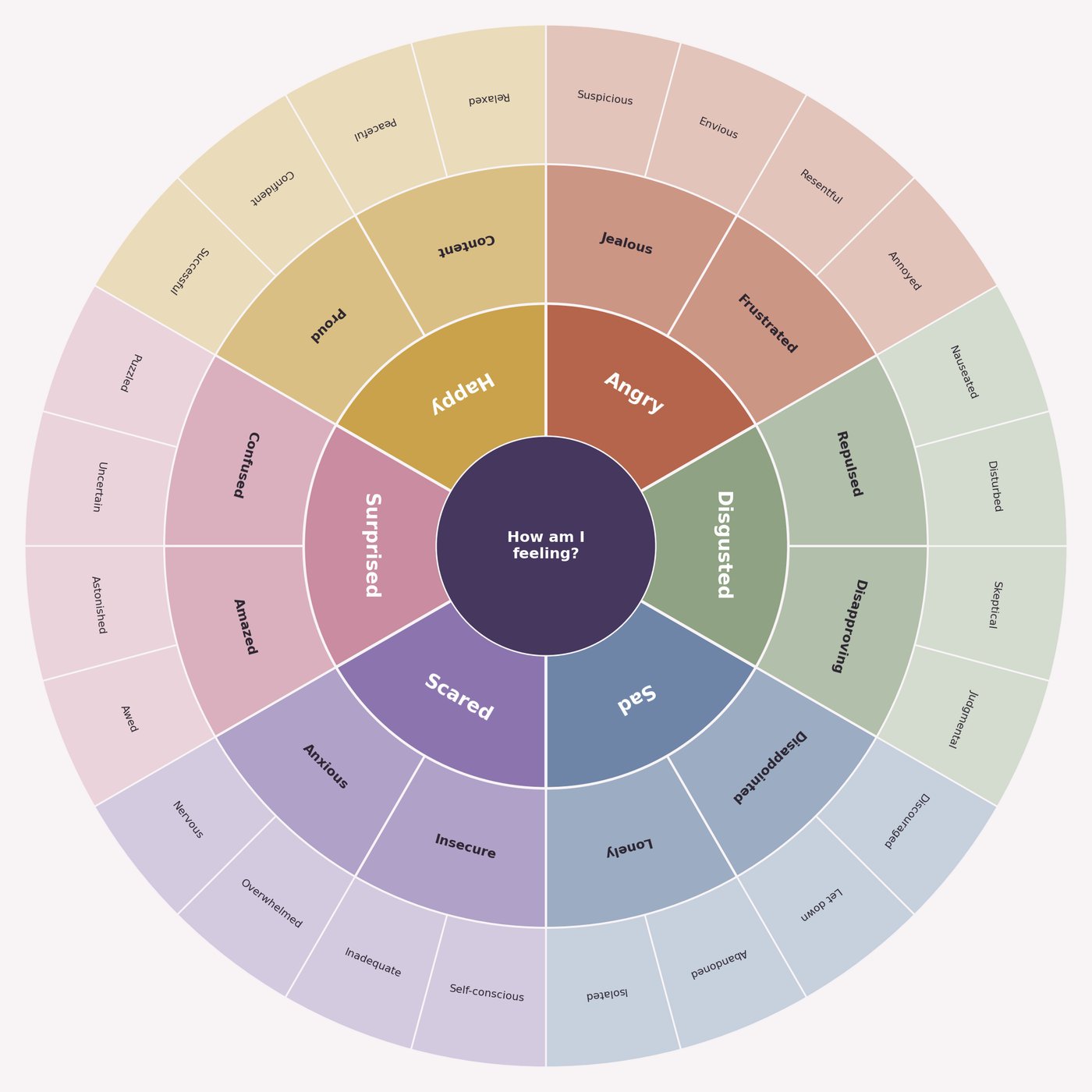
That's what a feelings wheel is for. It's a visual tool that starts with a handful of core emotions at the center and branches outward into more specific ones, so instead of landing on "bad," you might land on "disappointed," or "overwhelmed," or "resentful"—words that actually point toward what's going on and what might help.
Below is an original wheel I put together for this purpose. Start at the center and work your way out.
How to actually use it
It's less complicated than it looks. Three steps:
- Start in the center. Which of the six core feelings is closest to what you're experiencing right now? It doesn't have to be exact yet.
- Work outward. Follow that wedge out to the next ring. Does one of those more specific words fit better?
- Go as far out as feels true. The outer ring is the most specific. You don't have to land there every time—the goal is accuracy, not complexity.
Why specificity actually matters
Naming a feeling precisely does something practical: it turns a vague, overwhelming cloud into something you can actually respond to. "I'm anxious" and "I'm disappointed" call for different things from you—and from the people around you. Vague language tends to keep you stuck; specific language tends to open up a next step.
There's also a communication benefit. Telling a partner "I'm frustrated because I feel unheard" lands very differently than "I'm fine," said through gritted teeth. Precision is often the first step toward actually being understood.
A few ways to use it
- Daily check-ins. Glance at the wheel each morning or evening and pick the word that fits.
- Journaling prompts. Instead of writing about your day, start by naming the feeling, then write from there.
- With kids or teens. A wheel like this can help younger people build emotional vocabulary before they have the words on their own.
- Mid-conflict. Pausing to find the more accurate word can slow down a reactive moment enough to respond differently.
This tool is for general educational use and isn't a substitute for individualized care. If you're navigating something that feels bigger than a single word can hold, that's exactly the kind of thing therapy is for.